In-Person/Hands-on
Extended Weekend Training
Two Weekends in 2026 -- May 28-31 [completed] & September 24-27
- Registration Closes September 17 -
For Urban-Suburban-Rural Homesteaders
We'll share what we have learned and created over 2 decades.
Take the Pilgrimage to Midwest Permaculture
Stelle, IL - LIMIT 20 STUDENTS - Kick the Tires - Look Under the Hood
We made a commitment many years past toward living a more authentic, purposeful and meaningful life. Over this extended weekend, we will share what 20-years along this path has produced for us.

What if one were able to travel 50-100 years into the future… and arrive in a world that had figured out a way to feed and house everyone, live without wars, have simple yet secure and solid homes, plenty of affordable and healthy food, and they were living not only in harmony with the natural world but were actually leaving the planet in better and better condition, generation by generation.
Now, if we were to come ‘Back-from-the-Future’, many, if not most of the physical systems and activities that made that future culture possible, can be implemented into OUR lives today as we are beginning to implement here at Midwest Permaculture in Stelle, IL. What are these features?
Make the journey to Stelle and tour the residential yard of Midwest Permaculture (Bill and Becky’s home) and the 9-acre permaculture project we are guiding next door. See for yourself what we have been able to create with permaculture design thinking, a modest amount of capital and a good amount of elbow grease. We’ll show you everything of substance that we and our neighbors have created while you are here over a 4-day weekend experience. And we won’t sugar coat it.
Many feel we are in a time of growing uncertainty. As such, it’s more important than ever to do what we can to help shape a future rooted in resilience, wisdom, and care. One of the biggest statements we hear from people is “What can I do? I am only one person.” Actually, there may not be much that we can do individually to alter the big changes coming, but we can quietly begin to implement some of the changes that will have a positive impact on ourselves, our families and our neighbors, regardless of what happens. We can be the rock on the shore, the calm in the storm.
Each of us can be part of the solution.
Our ancestors, both recent and ancient, knew how to live simply, sustainably, and in harmony with the natural world. We too can live this way and move away from just a life of consumption toward a life of creation. We are each creative beings so why not work toward creating a world of beauty, wonder. security and abundance.
Whether you are working with a small urban lot or a nice sized rural property, this immersive workshop offers a smorgasbord of practical applications from food production and rainwater systems to community-building, personal health and regenerative design. You’ll gain real-world tools to support your journey toward a more-sane world.
Come join us. We will share all of the best ideas and projects we have implemented and learned from over this weekend. We won’t be holding back so come prepared to learn, grow and have what our students have called, the most valuable, Midwest Permaculture community experience, you will likely ever have. You will not only be learning about what we have done, but you will be able to see how a wider community is moving toward stabilizing their small piece of the world.
So, instead of feeling helpless in the face of the craziness of today, we can each become positive agents that are actually implementing the very solutions that will bring us closer and closer toward that beautiful future.
We have to do something with our days anyway. Why don’t we do what we can to build a little better world while unplugging from some of the numbing distractions and the madness that surrounds many of us each day?
What Will You See and Learn?

16 Key Focus Areas
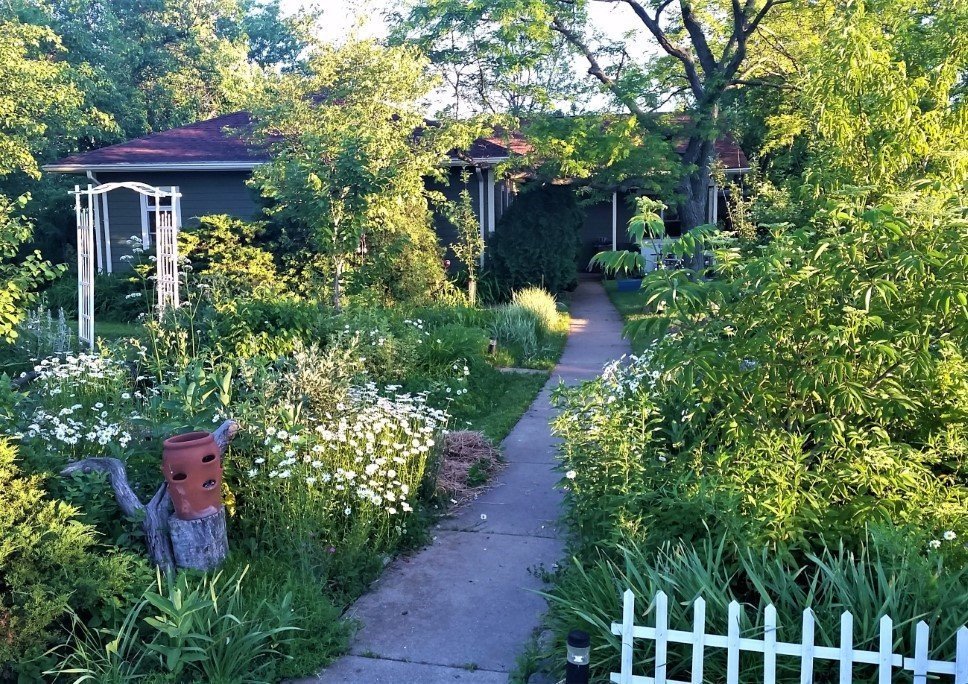
Walk the yard with Bill and Becky. They will share of the many ways they have ‘Permaculturized’ their residential property. Many students have commented that walking through the yard is like walking through an arboretum.


We will explore rain gardens, swales, aquaponics, hügelkultur, porous pavers, drywells, tanks, barrels, keylining, broadforking, deep rooted cover crops, organic matter, mulching and more. We’ll also show students how to use an A-frame, transit and laser level to find contour lines and determine if and where there is slope.


Our apple orchard was planted in 1975 consisting of over 150 trees of 6 different varieties. Fire blight showed up in 2005 and slowly destroyed over 70% of the trees.
This is when we really saw the vulnerability of a monocrop (just apples) and began to think long term. It became obvious we’d prefer to create a fully productive food forest with an overstory of various nut trees all the way down to a productive herb layer. We will include small livestock in the understory (silvopasturing).

The goal is to have 25-edible species in this food forest instead of just an apple orchard.
We are 10-years into a 40-year design and weekend participants of this training will be invited to be a small part of its restoration.
We dug our first swale in 2010 and since the downhill side of it was facing mostly south it became obvious that we would plant an overstory of fruit trees along the swale berm and shorter trees and shrubs downhill from there, turning it into a ‘linear’ food forest.

5 years later we had dug a second swale (pictured above) with the great help from many students (this time a hugelkultured swale) and once again, planted a row of fruit trees on the berm on the downhill side. Come and learn about our progress and setbacks and get a sense of how they feel, look and are maintained. We tried the STUN method of planting (Sheer-Total-Utter-Neglect) but most of what we planted died. No surprise there, so we decided to replant and this time provide some better care. That made a big difference and we’ll show what is working and what is not.
What is a hugelkultured swale you ask? See below…

Here is a cross section of the original conceptual design.

We designed a three-swale system capturing water and soaking it into the subsoil before it ran off the hillside. This ensures long-term water security for the linear food forests planted along them. Once the roots are down into the saturated subsoil, irrigation will rarely be needed again.


A plant guild is a grouping of plants that work together well to not only provide food for us, but also creates an ecologically balanced system that supports wildlife, soil development and water holding capabilities. These systems can be wonderfully attractive too. The neighbors (HOA?) won’t even know it is a food garden. :-)
Unlocking the full potential of wood for fuel.


Two of these were constructed primarily from natural and local materials. All three tours are hosted by the actual builder-owner-residents themselves. No second-hand information but actual pros and cons of building and living in these homes.


Our neighbors, Wayne and Bev, built this home themselves using AAC blocks (Autoclaved Aerated Concrete blocks) they chose due to their lightweight, insulating, and eco-friendly properties. There is a sample of the block you can hold. The inside of the home was finished with natural lumber and earth plasters. We’ll have time to pick their brains for details while there including during a couple of meals when they will join us. Their entire yard is ‘permacultured out’ as well. This is the location of the rocket mass wood heater we listed above.
While we are visiting our friends Jon and June at their strawbale home, we will also get a walk-through of their amazing in-ground, earth-bermed greenhouse that they have constructed. It is a design that Jon developed that uses the warmth of the earth and a solid bank of stone to keep the greenhouse above freezing all winter. And yes, they are even able to grow citrus in it — in Illinois!

It’s hard to believe what’s inside!
Jon walks us into the greenhouse.
Jon and June are incredibly knowledgeable and generous with their information. Once you walk through this greenhouse and understand how it works, you will have to wonder why this is not done everywhere in the temperate climate zones. It’s a game changer.
We’ll share of the simple modifications we made and what is involved in developing and caring for an ecologically sound pond system. We’ve had successes and challenges. We’re still learning…but we’ve learned a lot and we will share that.


This is the actual design we gave to our friend who owns his own earth moving equipment. From this he was able to clean up the old pond and reshape it into something much more functional for a cleaner and more ecologically balanced system.
Basics of Plant Propagation
We have only purchased about a third of the plants that we now enjoy on the MWP residential property and on the larger land project next door. Most of the plants we have we propagated from the plants of friends and associates of ours. Plant propagation can one’s lifetime work but the basics can be understood and experienced in a few simple workshops.


We’ll explore a variety of ideas from drying to fermenting, freezing, canning, root cellaring and more.


Compost tea is not something you make to out of compost for us to drink, it is made for our plants to drink.
Compost teas can be made simply at home and give our plants added fertility from our own household waste streams. They can be poured around the roots of the plants or sprayed directly on the leaves as a foliar spray which allows the plant to pick up the nutrients more quickly.

And not all compost teas are made equal, nor do they need to be. We’ll explore some of the simple ways we make our compost teas and the best way we have evolved to apply our teas as foliar sprays. We’ll share all our best tricks.

What are the differences between set grazing, mob grazing and rotational grazing? You’ll be invited to join us as we move our goats while also learning the basics of how we use solar-powered electric netting.


Human waste does not need to be considered a pollution problem. We have developed (with much trial and error) what we call the ‘Super-Clean Composting Toilet System’ that is surprisingly simple to use, maintain and benefit from. And there are, for all practical purposes, no unpleasant odors…!!! You have the opportunity to take a close-up look at this entire system.


Cover crops, sheet mulching, roller crimping, self-watering beds and aquaponics can all significantly support one’s annual gardening efforts.


We stumbled upon this simple and flexible work horse system when Bill inherited an electric golfcart upon his father’s passing several years ago. A few simple tweaks and we think we have found THE game changer for efficiency around a small homestead.


Just the Details Please…
- This is a jam-packed, 4-day training (Thurs. afternoon through Sunday noon) open to anyone who learns best by seeing and doing. (Schedule Below)
- We will be showing you everything that we, and a few of our neighbors, have been working on for 20-years.
- There will be some optional hands-on experiences available such as digging a rain garden and planting a guild.
- All meals are provided for and will be prepared from as much organic and local foods as possible. We can have vegan and vegetarian options available. There is a place on the registration form to specify this.
- Tent space is available for free as part of registration. We also have some rooms to rent in the community and there are motels 20-30 minutes away. See bottom of this page for Stelle lodging options.
- We limit the number of students to 24 due to our modest space and to increase the quality of the learning experience for each student. You reserve your space by registering early.
- If you wish to enroll in our online Permaculture Design Certificate (PDC) course to significantly deepen your permaculture knowledge, you can purchase it as well any time before, during or after this weekend experience. These two trainings dovetail together beautifully but also stand alone in themselves. There is a $200 discount when taking both trainings. The order in which you take the trainings is not important.
- Midwest Permaculture is located 75-miles South of Chicago’s Midway airport. If you wish to take public transportation (plane, train, bus) there is a $2 shuttle that runs between Midway airport in Chicago to the Kankakee area. We can pick you up in Kankakee and bring you to Stelle for $80. Two students? That’s $40 each. Details Here.
Student Feedback


Extended Weekend Training Price:
$895
$200 Off for Second Person (or more)
If you have a family member or friend who would like to take this weekend training with you, we offer a $200 discount. And you can invite more than one additional person at this discounted price. Contact Milton for all group registrations.
If there is someone(s) who is intimately involved in whatever project you are undertaking, our students have repeatedly told us that it really made a difference to them when all parties involved took the training together. There is just too much information shared and too many impressions gained from a training like this to be able transfer it by conversation later on to others.
All we can tell you is that most people experience an inner shift by the conclusion of our trainings and to be able to experience this with those you will be working closely with, well, it’s priceless. If there is any way the other(s) involved with your project can join you, we, and most all of our students, highly recommend it.
Discounted Price for our PDC Students:
$695
To our PDC Students… Whether your training was in person or online, or maybe you are currently a registered student and working your way through our Online PDC Course? Walking our site and seeing so many applications up close is a powerful confirmation along your permaculture journey. Just contact Milton for the $200 savings and he will send you a coupon code.
If you are not one of our Permaculture Design Certificate (PDC) course students, but wish to be, you can sign up for our internationally recognized Online PDC course at the same time here with this Extended Weekend Training and start learning right away. There is no serious pro or con to taking the PDC Course before or after this in-person experience. They are stand alone trainings and equally impactful. The option to purchase both at the same time appears in the registration block below. You'll save $200.

Contact Milton with any questions or special registration options such as group discounts, sharing a room, or other special situations.
About the Training Location

Bill and Becky have been an integral part of this community for over 45 years. It is where they found each other, raised 4 boys, and together, developed a deep connection to permaculture, land stewardship, and authentic community.
Stelle offers a simpler lifestyle and a safe, family-oriented environment. Through cooperative endeavors around gardening, tool-sharing, community maintenance and various social activities, Stelle residents have created opportunities to experience authentic community and enjoy a high-quality of life.
The Home Residence of Midwest Permaculture
Bill and Becky have been nurturing the permaculture design around their home for 2 decades now. They enjoy touring interested people through their yard, answering any questions, and sharing of the challenges, joys, and learning experiences they’ve experienced from “walking the talk” of permaculture design.
Over that time, they have turned this suburban parcel into a beautiful, productive, and ecologically friendly oasis that preserves rainwater, supports native pollinators, provides a wide variety of foods, and builds soil in the process. Seeing this property up-close and understanding its design intricacies can be deeply inspiring.


Center for Sustainable Community (CSC) Design
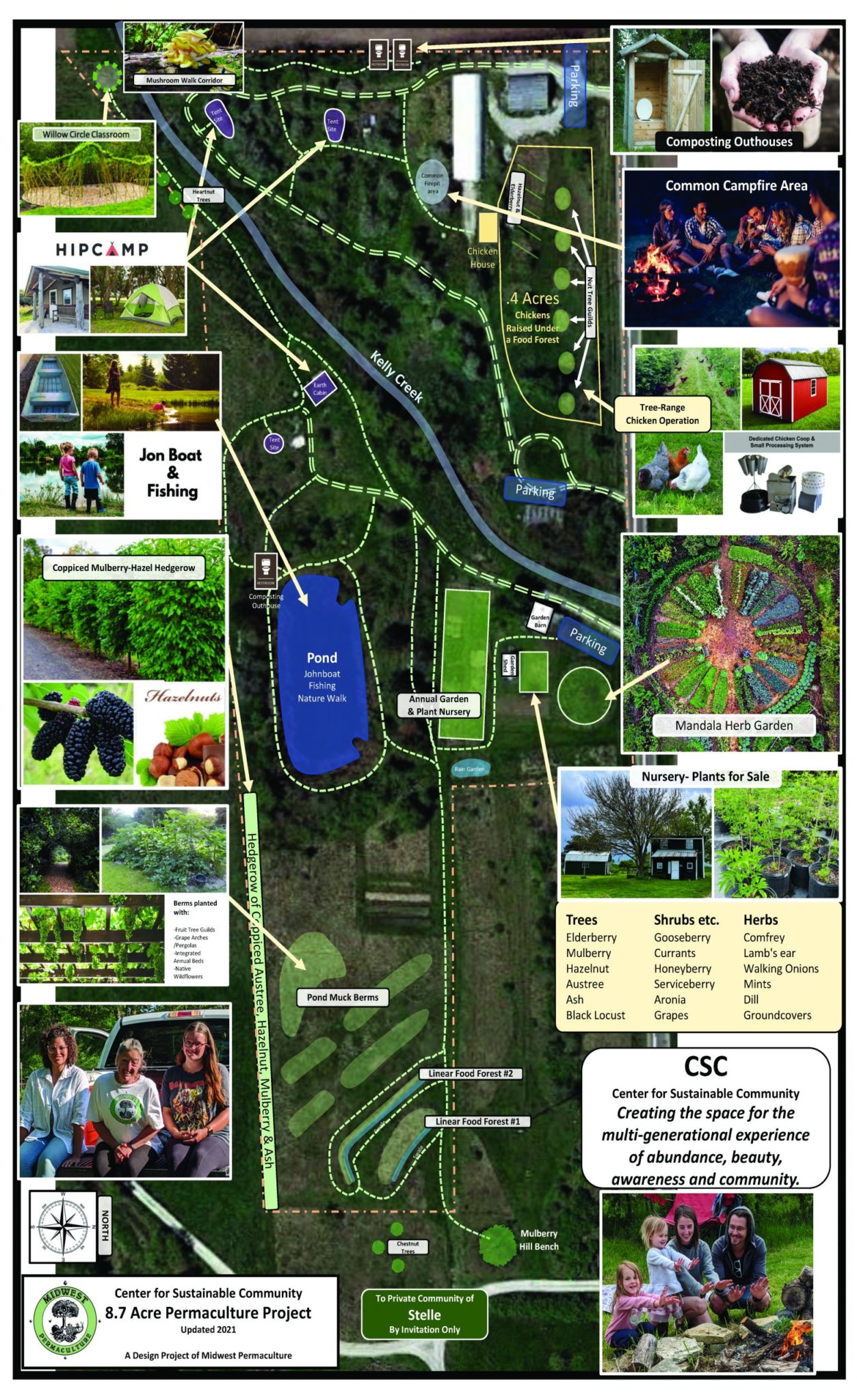
Midwest Permaculture has also been very involved in a permaculture land design for CSC, Stelle’s local nonprofit that owns 8.7 acres immediately adjacent to the community.
It is here where we have been implementing larger-scale design elements such as ponds, swales, beginning food forests, a community garden, some small livestock raising, and natural building.
CSC’s design is a great example of how a permaculture vision can change over the years as it matures. We will spend quite a bit of time exploring the land and will share much about the design elements we have implemented.
Becky and Bill are 2 of the 6 founding members of CSC and Becky currently serves on the board.
Full Schedule
From 4pm on Thursday - Sunday Lunch
Arrival and Registration: Thursday 2:00-3:30pm
Arrive any time after 2:00pm to register and set up your tent or get settled into your already reserved lodging option.
We'll Begin Promptly at 4:00pm
4:00 Welcome Tour – 6:00 Dinner – 7:00 Evening Activity
Ends With Lunch on Sunday
There will be a couple of optional activities following lunch.
Timeline: Fri., Sat., & Sun. morning
7:00 Coffee and Tea On
7:15 – 8:15 Breakfast
8:15 – 12:15 Morning Sessions
12:15 – 2:00 Lunch Break
2:00 – 5:00 Afternoon Sessions
5:00 – 6:00 Break
6:00 – 7:00 Dinner
7:00 – 9:00 Optional Evening Sessions
As you can see, these are very-full days. But because we pepper in plenty of flexible breaks, students enjoy going into the evenings without feeling fatigued.
“Bill, I was concerned coming in that I would not be able to learn anything by the evening sessions. Not so. With the long meal breaks and the way that you and your team kept the material so interesting, I was fully engaged all day. Great job. I didn’t want the training to end.”
Rebecca – 48 – Social Worker
Low Risk Cancellation and Refund Policy
We offer a full refund less $25 if canceling more than 60 days before the start of the training; Less $100 if canceling between 60-30 days out; and less $150 if canceling withing 30 days of start date. There are no refunds for cancellations once the training begins.
In certain circumstances we will consider the part not refunded as partial or full credit towards a future training or course.
Do you have any questions about the training, lodging or other incidentals?
Feel free to contact Milton with any questions.


A Few More Details...
Open Camping Included
You will need to bring your own tent and sleeping gear. There are plenty of tent camping spots within a relatively short walking distance to the community center where we will meet daily and enjoy our meals. Since you will just be sleeping in your tent you won’t need your cooking gear.
Bathrooms / Showers / WiFi
Beside our Super Clean Composting Toilet, campers will have access to our community center 24/7, which has two bathrooms, one shower, decent internet and a coin-op laundry. There will be access to a second shower right near the community center as well.
Lodging Options
If having a roof over your head is more your style, we have several rooms available to rent from both our community center and from some of our friendly local residents who love hosting our students in their spare guest bedrooms.
If you are interested in these, there is a place on the registration link to request this option. The costs run between $150-$300 for the full weekend. These are offered on a first-registered / first-choice basis.

There is also CSC’s earth-shelter cabin. This rents for $240 for the three nights. Here is our blogpost about how we built the cabin. Keep in mind that we will need to tour it as a part of the course at one point over the weekend.
And finally, there is always the option of renting a motel room anywhere in the surrounding area. There are several decent motels within a 20-35 minute drive from Stelle. We have not specific recommendations on this.
Questions?
Feel free to call or email Milton if you have any questions about lodging or about anything else regarding this extended weekend training.
Phone: 815-216-4124

We would love to have you join us.
The experience of taking a training in Stelle tends to be deeply impactful. As teachers, we feel it is our job to deliver the best quality training we know how to our students, and we take this responsibility seriously. The subject of permaculture is too brilliant to share in a ho-hum way. We see the course as a journey into wonderment, self-confidence, and endless possibilities.